Table of Contents
Choosing the best kitchen cabinet materials is about far more than style and color. The core materials determine whether your investment will look and perform beautifully in 10, 20, or even 30+ years.
As specialists who build and install hundreds of kitchens, we’ve seen how the right (or wrong) materials perform under real-world conditions — steam, spills, heavy stone countertops, seasonal humidity swings, and daily use.
Here’s a clear breakdown of the most common materials for cabinet boxes and doors.
Best Kitchen Cabinet Materials for 2026: 4 Options for Long-Term Durability
Kitchen cabinets face constant challenges:
- Moisture from cooking and cleaning
- Heavy countertops (especially quartz and granite)
- Repeated opening/closing
- Humidity fluctuations
Poor material choices lead to swelling, sagging, loose hinges, and premature failure. The cabinet box (the hidden structure) is more critical for longevity than most people realize.
Cabinet Box Materials Ranked for Durability
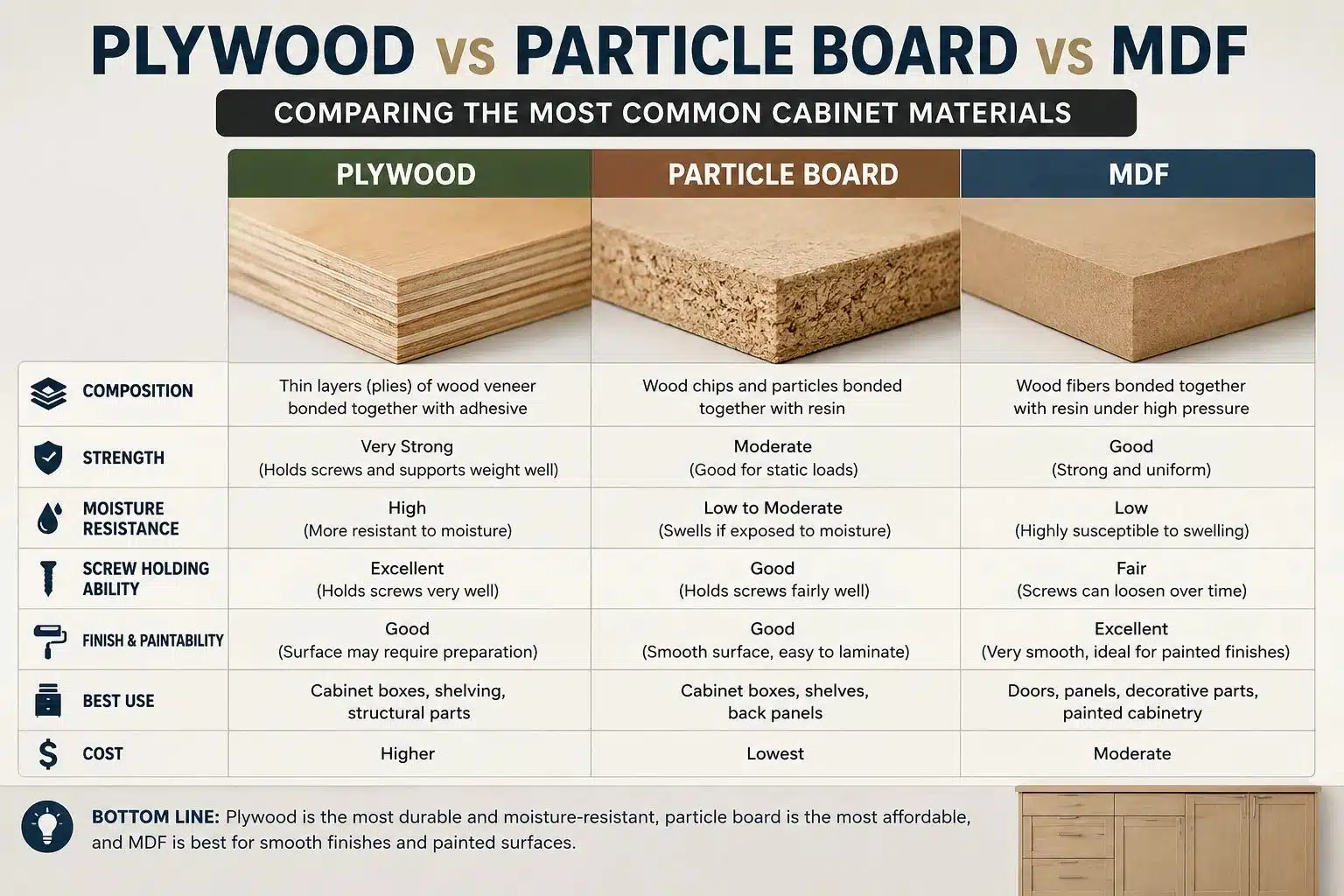
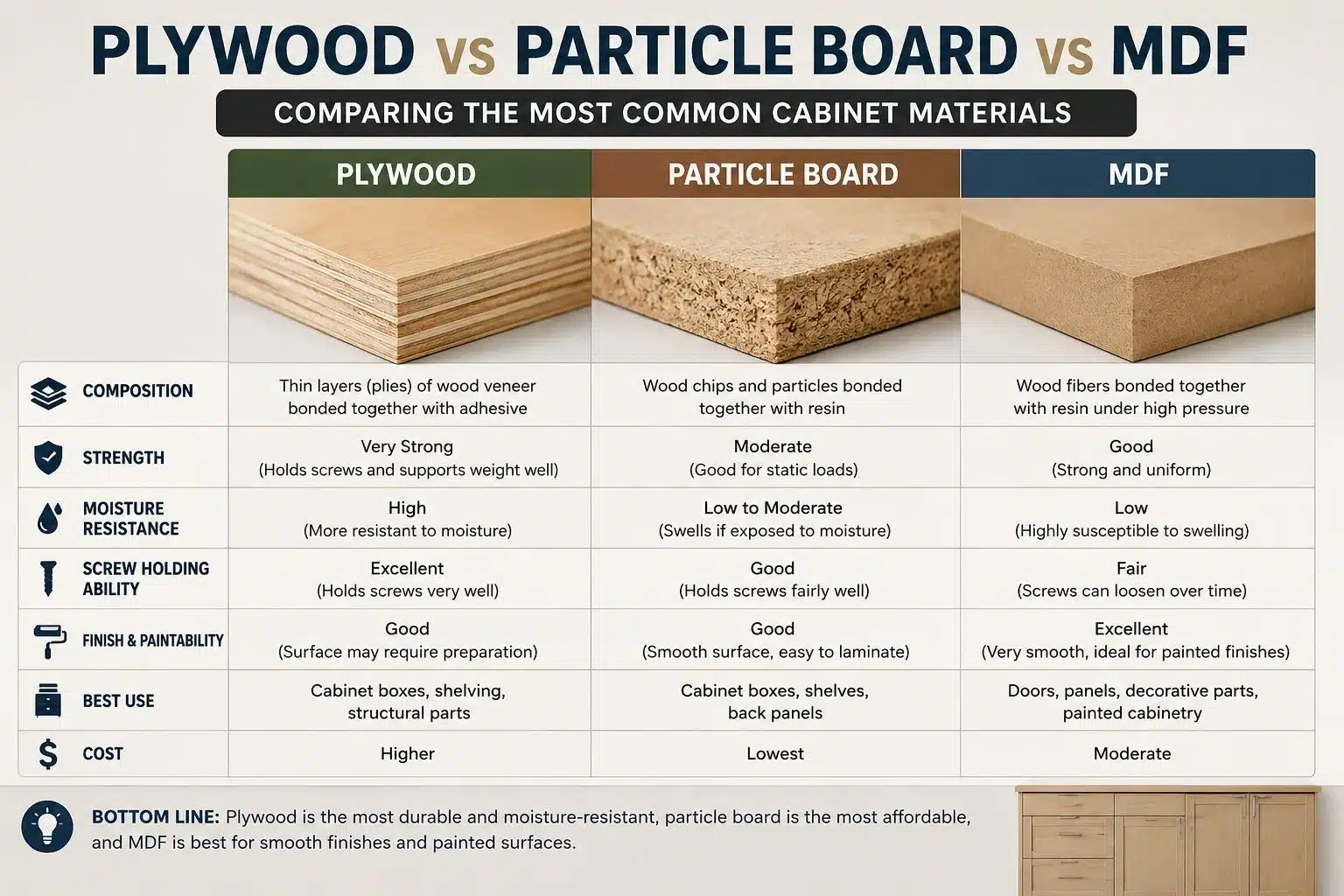
1. 3/4″ Cabinet-Grade Plywood (Top Recommendation) Plywood is the gold standard for cabinet boxes when long-term performance is the priority. It is made from multiple layers of wood veneer bonded with alternating grain directions, delivering superior strength, dimensional stability, and screw-holding power.
Key advantages:
- Excellent moisture resistance (handles incidental spills and humidity far better than composites)
- Superior screw retention for hinges, drawer slides, and heavy loads
- Strong structural integrity that resists sagging under stone countertops
- Proven service life of 20–40+ years with proper construction
For homeowners planning to stay in their home long-term, 3/4″ plywood boxes are the best investment.
2. High-Quality Canadian Particle Board Modern high-density Canadian particle board has come a long way. When manufactured to premium standards, it offers a dense, consistent core that performs well in most residential kitchens.
It provides an excellent balance of strength, affordability, and stability. However, it remains more vulnerable to prolonged moisture exposure than plywood. Proper edge sealing and quality construction are essential.
3. Standard Particle Board Lower-density particle board is the most budget-friendly option. While acceptable in very dry, low-use applications, it has weaker screw-holding, lower moisture resistance, and is more prone to swelling if water reaches the core. Quality varies significantly between manufacturers.
4. MDF (Medium Density Fiberboard) MDF is smooth and stable but not ideal for cabinet boxes. It absorbs moisture readily and swells permanently once compromised. We generally reserve MDF for painted doors and decorative components rather than structural boxes.
Cabinet Door Materials
Doors face different demands — they need to look beautiful while withstanding daily wear.
1. Solid Wood (Premium Choice) Solid wood doors (especially hardwoods like maple, oak, or cherry) remain the gold standard for beauty, repairability, and longevity. With proper finishes, they can last decades and be refinished multiple times.
2. HDF / MDF or Particle Board with High-Quality Melamine Engineered cores paired with durable melamine surfaces are extremely popular and practical. High-pressure melamine or thermofoil offers excellent scratch and stain resistance while being easy to maintain. HDF (High Density Fiberboard) is preferred over standard MDF for doors because of its greater strength and impact resistance.
3. Painted MDF Doors MDF delivers the smoothest surface for painted finishes, making it ideal for clean, modern looks. Quality painted MDF performs well when edges are properly sealed and the kitchen environment is controlled, though it is more susceptible to moisture and impact damage than solid wood.
Quick Comparison Table
| Material | Best Use | Moisture Resistance | Screw Holding | Relative Cost | Expected Lifespan |
|---|---|---|---|---|---|
| 3/4″ Plywood | Cabinet Boxes | Good | Excellent | Higher | 20–40+ years |
| High-Quality Particle Board | Budget Boxes | Moderate | Good | Medium | 10–20+ years |
| MDF | Painted Doors | Poor | Moderate | Medium | Varies (doors better) |
| Solid Wood | Doors | Good (sealed) | Excellent | Highest | Decades |
Our Expert Recommendations
For Maximum Durability 3/4″ plywood cabinet boxes paired with solid wood or high-quality HDF/melamine doors. This combination offers the best long-term performance and resale value.
For Best Value High-quality Canadian particle board boxes with durable melamine or painted HDF doors. This delivers reliable performance for most families without the premium price.
Pro Tips from the Shop Floor
- Always prioritize proper edge banding and sealing, especially around sinks and dishwashers.
- Quality hardware (soft-close hinges and full-extension slides) dramatically improves performance regardless of material.
- Ask suppliers: What thickness and grade of plywood? Is it cabinet-grade? How are edges sealed?
Final Thoughts
There is no single “perfect” material — the right choice depends on your budget, lifestyle, home environment, and how long you plan to stay.
If durability is your top priority, invest in plywood boxes and solid wood doors. If you want an excellent balance of performance and value, high-quality particle board with melamine is a smart, proven solution used successfully in thousands of kitchens.
Best Kitchen Cabinet Materials isn’t always the most expensive — it’s the one built with the right materials, proper construction, and attention to detail that will serve your family beautifully for decades.
Browse our Bathroom Vanities.
For more information about hardwood plywood standards, visit the Hardwood Plywood & Veneer Association.